
There are usually two readers connected to the access point, one of which can be used to provide entrance to the room and the other to exit.
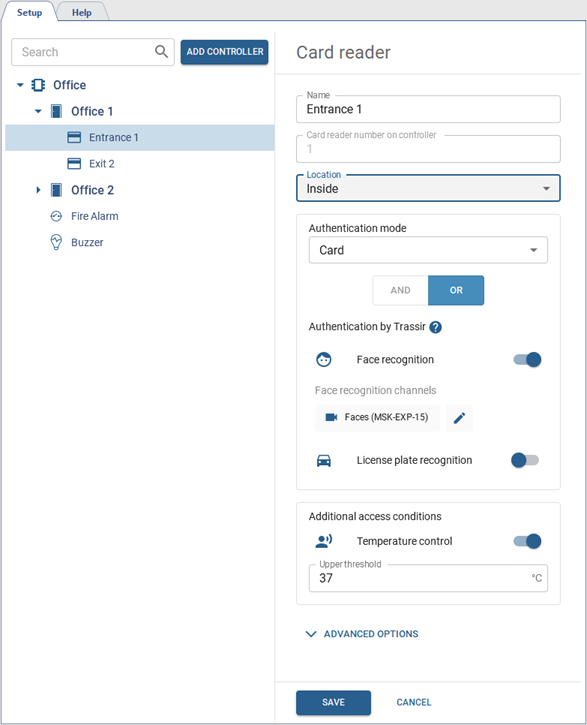
To configure the reader, enter its Name and select Location. In the Authentication Mode setting, select the method by which the person will verify their identity: card, card and PIN, card and face, fingerprint, etc.
Tip
The amount of the authentication modes depends on the functionality of the connected card reader.
If necessary, configure additional reader settings.
-
Configuring additional Authentication Mode capabilities
Server plugins can be used for authentication. Enable the appropriate plugin in the Authentication by TRASSIR setting and configure its parameters.
Important
The simultaneous use of Authentication by TRASSIR and Passage confirmation is not available.
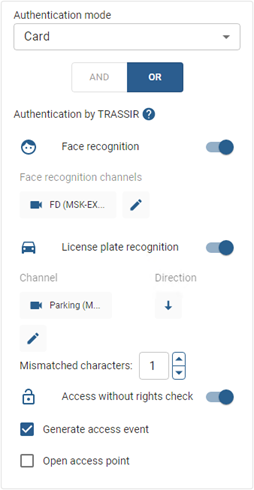
Select AND in order to enable simultaneous use of Authentication mode and Authentication by TRASSIR. Select OR to use any of the configured authentication methods.
Tip
If AND is selected, the time between the two authentications (Authentication by TRASSIR and Authentication Mode) depends on which authentication happens first:
-
no more than 10 seconds, if the first authentication is via the reader (specified in the Authentication Mode field);
-
no more than 20 seconds, if the first authentication is Authentication by TRASSIR.
Table 103.
Important
The Face Recognition function is available only if the Face Recognizer plugin is enabled.
The number of video channels used for face recognition is determined by the number of corresponding licenses and the settings of the Face Recognizer plugin.
The face database will be used for the face recognition.
For more information on the Face Recognizer plugin settings, see TRASSIR Face Recognition.
If the Face Recognizer plugin will be used for authentication, then enable it, and in the Face Recognition Channels field, specify the video channels that will be used for authentication.

Important
The License Plate Recognition function is only available if the AutoTRASSIR plugin is enabled.
The number of video channels used for license plate recognition is determined by the number of corresponding licenses and the settings of the AutoTRASSIR plugin.
For more information on the AutoTRASSIR plugin settings, see AutoTRASSIR/AutoPass.
If the AutoTRASSIR plugin will be used for authentication, enable License plate recognition, and in the Channel field, specify the video channel that will be used for authentication.
Tip
The license plate numbers specified in personnel settings will be used for license plate recognition.
If the Shared license plate number feature is enabled in personnel settings as an identifier, it is recommended to select the AND option.
When selecting the OR option, the person will be recognized as an Unknown Person with an event Access Denied.
Select the direction of vehicle movement and define the error (from 0 to 3 Mismatched characters) with which the search for license plates in the person parameters will be performed.
Tip
For example, if the Mismatched symbols setting value is set to 1, and one of the person has the 6063361 number.
If AutoTRASSIR makes a one character error when recognizing a license plate number and instead of 6063361 recognizes 606336 or 4063361, the wrongly recognized number will match the person's number due to the set inaccuracy, and TRASSIR ACS will let the vehicle through.
Configure access without person identification in the Access without rights check group settings to simplify the process of vehicles entering or leaving the protected area.
Enable the Generate access event so that the ACS ignores access levels and generates an Access granted event for all vehicles with a number, which will appear in the Access Control Log of the operator interface.
If the Open access point is enabled, after generating the Access granted event, the command Open once will be sent to the access point.
-
-
Additional access conditions configuration
Table 104.
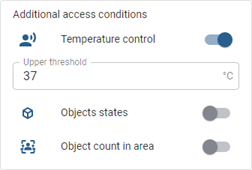
The Additional access conditions parameter lets you enable the Temperature control for persons authenticating with this card reader. In case the employee has a temperature above the value specified in the Upper threshold field, the event log will display a corresponding warning and the entry will be blocked for this person.
Tip
Select the Temperature mode in the Authentication mode setting, enable Temperature control and set the Upper threshold to make the reader operate in the thermometer mode, determining the temperature of people passing by. Other modes of authentication will not be available in this mode.
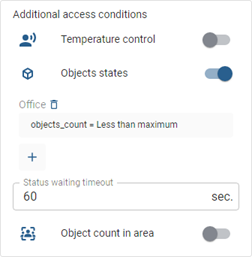
You can enable the Objects states option to specify the state of GPIO inputs, outputs and/or areas required to grant access after successful authentication by identifier.
Access will be granted only once—after the object's state changes to the one specified in the settings and within the time set in the Status waiting timeout field.
Tip
If the authentication settings are configured for simultaneous use of Authentication mode and Authentication by TRASSIR, and the AND option is selected, the time between the two authentications is determined by the value specified in the Status waiting timeout field.
Based on the data received from the object counting in the area function (see Areas), you can configure the passage restriction based on the number of objects.
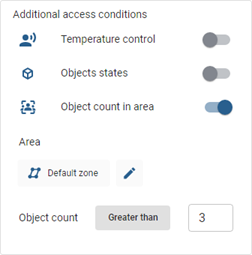
To determine the Object count in area, the video is analyzed by the Neuro detector plugin.
Important
The Object count in area function is available only if the Neuro detector plugin is enabled.
The number of video channels used for object recognition in the area is determined by the number of corresponding licenses and the settings of the Neuro Detector plugin.
All channels used to detect objects in an area must have an area defined. The area must be located as close as possible to the access point (turnstile or door).
For detailed Neuro Detector configuration, see TRASSIR Neuro Detector.
If you enable the Object count in area option, select the Area and set the Number of objects parameter, access will be allowed only if the number of objects in the selected area matches the value specified in the parameter.
- Greater than: access is allowed if the number of objects in the area is strictly greater than the specified value.
- Equal to: access is allowed if the number of objects in the area is equal to the specified value.
- Less than: access is allowed if the number of objects in the area is strictly less than the specified value.
Important
The number of readers used to detect objects in an area is determined by the number of LICENSE_PACS_VA_PASS_DETECTOR licenses purchased in addition to the base TRASSIR ACS license on the server.
Available licenses are listed in the server settings on the tab License.
-
Rules of passage configuration
Table 105.
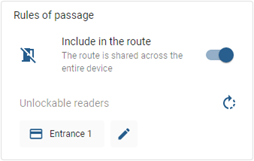
In order to build a passage route in a certain area or inside a building, use the Rules of passage setting. Set the Include in the route flag and select the readers to configure the rules. The Unlockable Readers list will contain the readers that will become available after passing through the customized reader.
For example, if you have two readers, you can specify the second reader in the settings of the first reader and the first reader in the settings of the second one. Thus, after passing through the first reader, the second reader will be activated and vice versa. In this case, the visitor will be able to enter through the first reader, but exit only through the second one. Further passes through the same reader will not be available.
You can build more complex routes if you have three and more readers.
Click
 , to reset the current person's location and let the person authorize again.
Important
Features of rules of passage usage:
- The rules of passage setting is available only on Hikvision and TRASSIR TR-C241/TR-C481 readers.
- You can build only one route on one device. For the pass rule to work, the flag Include in the route must be set on all configurable readers.
- The feature interacts directly with the card readers and doesn't need constant server connection to the card reader. At the same time, the cards on the device will be rewritten after any change in the feature settings.
- The feature is not supported when the access point connected to the card reader is included in the Software gateway (see Rules of passage).
-
Detection of passage violations
Table 106.
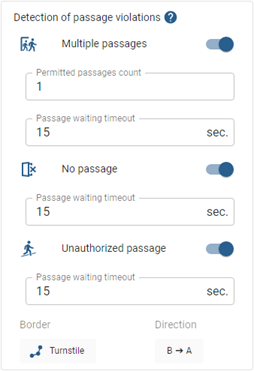
For Detection of passage violations, the video is analyzed by the Neuro detector plugin.
Important
The Detection of passage violations function is only available if the Neuro Detector plugin is enabled.
The number of video channels used for detection of passage violations is determined by the number of corresponding licenses and the settings of the Neuro Detector plugin.
All channels used to detect violations must have a passage border defined. The border must be located as close as possible to the access point (turnstile or door).
For detailed Neuro Detector configuration, see TRASSIR Neuro Detector.
In the settings, you can select the types of violations that will be detected when they occur:
- Multiple passages: crossing the border by several persons with one authorization (commonly called "tailgating" or "piggybacking").
- No passage: a person presents their ID without actually crossing the border.
- Unauthorized passage: crossing the border without presenting an ID.
For each detected violation, you must specify a Passage waiting timeout during which the Neuro Detector border is expected to be crossed.
For the Multiple passages violation, in the Permitted passages count parameter, specify the number of people who can pass through with one authorization, if this option is provided.
To configure the detection of passage violations, in the Border parameter, select the border previously defined in the Neuro Detector settings on the channel.
In the Direction parameter, specify the direction of movement of the persons.
Important
The number of readers used to detect passage violations is determined by the number of LICENSE_PACS_VA_PASS_DETECTOR licenses purchased in addition to the base TRASSIR ACS license on the server.
Available licenses are listed in the server settings on the tab License.
-
Advanced settings of the reader
Table 107.
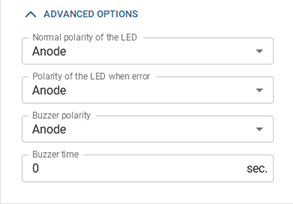
The reader's Advanced options let you change the polarity of the light indicator and the buzzer, as well as the duration of the alarm.
Tip
Using readers, you can configure various rules that will be executed depending on their current state.
See more on setting up autonomous rules in Autonomous rules settings.
